The $1.5B Standoff: Why Warner Bros. Refuses to Flinch in the “Dunesday” Box Office War
Hollywood is bracing for “Dunesday”—an unprecedented December 18 box office showdown between Dune: Part Three and Avengers: Doomsday. Despite Marvel’s staggering $16.5M single-day presale gross, Warner Bros. holds a master card that changes everything: a 3-week global IMAX monopoly. Here’s why WB isn’t backing down, and why Marvel might be forced to move first.
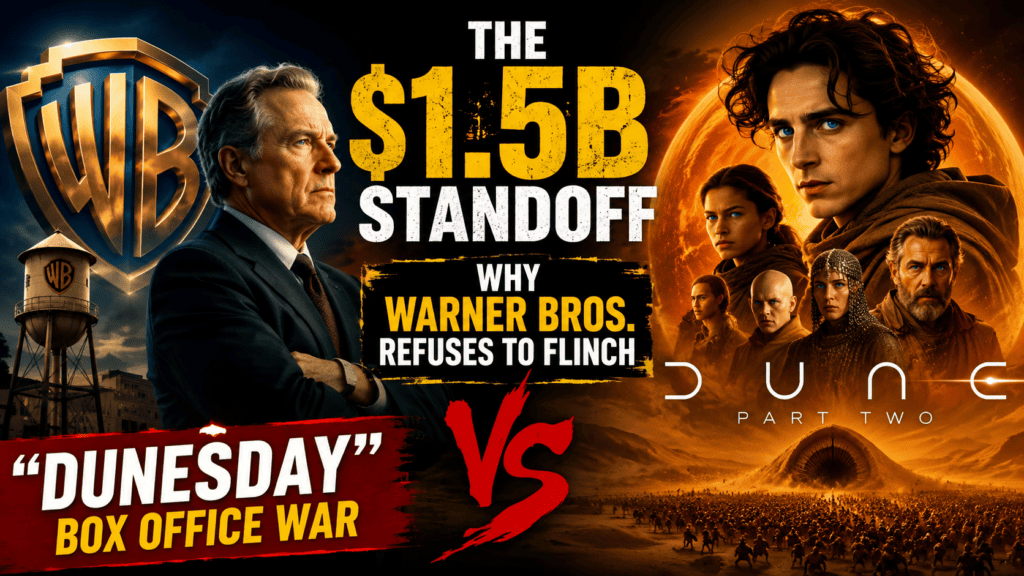
Get ready for the biggest box office battle in modern cinema history. On December 18, 2026, two massive Hollywood titans are set to clash head-on: Warner Bros.’ Dune: Part Three and Disney’s Avengers: Doomsday.
Dubbed “Dunesday” across film communities, this direct showdown isn’t a friendly, complementary double-feature like 2023’s Barbenheimer. It’s a ruthless fight for screen dominance. And despite Marvel’s eye-popping $16.5 million single-day presale gross on its newly minted “Infinity Vision” screens, Warner Bros. isn’t backing down an inch.
Here’s why WB holds the high ground, why Marvel might be forced to make the first move, and how a brutal contract play changed the rules of the holiday box office.
The Masterstroke: Warner Bros. Locked Marvel Out of IMAX
The seeds of “Dunesday” were planted when Warner Bros. and Legendary Entertainment staked out December 18, 2026, for Denis Villeneuve’s trilogy finale. To secure their turf, WB executed a massive power move: a three-week global exclusive master contract with IMAX Corporation.
When Disney later reshuffled its Phase Six calendar and dropped the Russo Brothers’ Avengers: Doomsday directly onto the same date, history suggested Warner Bros. would blink and delay Dune. After all, major studios usually run for cover when an Avengers movie enters the chat.
Instead, Marvel hit a massive brick wall. Without access to IMAX auditoriums—which generate a huge portion of Marvel’s premium opening-weekend surcharges—Disney was forced to launch “Infinity Vision.” This proprietary certification program forces theater owners to submit individual screens for Marvel approval, meeting strict standards for dual-laser projection and multi-channel spatial audio just to create an alternative to IMAX.
Tale of the Tape: The Financial Asymmetries
Why is Warner Bros. so confident? It comes down to the fundamentally different business models behind both blockbusters.
| Strategic Metric | Avengers: Doomsday | Dune: Part Three |
|---|---|---|
| Distributor / Production Co. | Walt Disney Studios / Marvel Studios | Warner Bros. Pictures / Legendary |
| Director(s) | Anthony & Joe Russo | Denis Villeneuve |
| Primary Large-Format Venue | Infinity Vision (Proprietary) | IMAX Exclusive (3-Week Window) |
| Star Power | RDJ (Doctor Doom), Chris Evans, Chris Hemsworth, Pedro Pascal, Florence Pugh | Timothée Chalamet, Zendaya, Robert Pattinson, Jason Momoa, Florence Pugh |
| Estimated Break-Even Floor | ~$1.5 Billion Worldwide | ~$600–$700 Million Worldwide |
| Opening Presale Flex | $16.5M in 24 Hours (Infinity Vision) | Standard Horizon Booking Schedule |
For Disney, Avengers: Doomsday is a massive financial risk. Massive cast contracts—including Robert Downey Jr.’s return as Victor von Doom alongside Chris Evans and Chris Hemsworth—and high VFX overhead mean the film needs ~$1.5 billion just to break even. It demands immediate, wide-scale audience saturation.
Dune: Part Three, on the other hand, carries a break-even threshold closer to $600–$700 million. Because Warner Bros. controls every global IMAX screen for the first three weeks, Dune guarantees itself the highest average ticket prices in the industry. It doesn’t need to out-draw Marvel on raw foot traffic to turn a massive profit—it just needs to keep those high-margin IMAX seats filled.
Holiday Elasticity: Why December Isn’t Summer
Pundits point to 2016, when WB moved Batman v Superman out of May to avoid Marvel’s Captain America: Civil War. But applying a summer playbook to late December completely misses how holiday moviegoing works.
In the summer, opening weekends are everything. In late December, the rules change:
- The Holiday Stretch: Between Christmas Eve and New Year’s Day, weekday box office numbers regularly match weekend grosses because schools and businesses are closed.
- Demographic Split: Avengers relies on front-loaded, PG-13, fan-driven opening weekend crowds. Dune attracts an older, prestige sci-fi audience that prefers premium large-format screens and stretches out its viewing over several weeks.
- The Florence Pugh Effect: In a fun twist of holiday cross-shopping, Florence Pugh stars in both movies (as Princess Irulan in Dune and Yelena Belova in Avengers), proving the audiences naturally overlap rather than cancel each other out.
Prediction: Will Marvel Make the First Move?
Warner Bros. has zero incentive to yield. Abandoning December 18 would mean surrendering a contractually locked three-week global IMAX monopoly that would be impossible to replicate elsewhere on the calendar.
Instead, the operational pressure is actually on Disney. Industry chatter suggests Marvel might pull a classic play from their Infinity War and Endgame playbooks: moving Avengers: Doomsday up by one week to December 11, 2026.
A one-week jump gives Marvel:
- Seven days of uncontested access to global IMAX screens before Dune takes over.
- A massive, unencumbered opening weekend to gobble up fan momentum.
- Perfect positioning to roll into its second weekend right as Christmas break kicks off.
Whether Disney shifts dates or holds the line, one thing is certain: Warner Bros. has played its cards masterfully, ensuring Dune: Part Three isn’t retreating for anyone.
About The Author